History of advent calendars
Before beauty boxes and gin drams, advent was chalk on a door and a biscuit sewn to cardboard. Here is how a German countdown became Britain's favourite December habit — and why we still open a door a day.

Advent means arrival. In Christian calendars it is the stretch of waiting before Christmas, traditionally marked with candles, hymns and a bit of holy impatience. The cardboard grid with twenty-four little doors is newer than most people think — and far older than the £200 beauty box that now sits next to it in the shopping basket.
Chalk, candles and homemade treats
The roots sit in nineteenth-century German Protestant homes. Families counted the days with chalk marks rubbed off a door or wall, candles burned down to the next notch, or pictures hung one by one. Homemade versions show up in accounts from the mid-1800s — the German Christmas Museum, for example, points to a children's book scene from 1851. The idea was simple: make waiting visible, and give children something to do with their hands while December crawled.
One story that stuck belongs to Gerhard Lang, a Swabian pastor's son later based in Munich. As a boy, his mother is said to have sewn twenty-four little Wibele biscuits onto cardboard so he could eat one a day. Years later he turned that memory into print.
From cut-and-paste to tiny doors
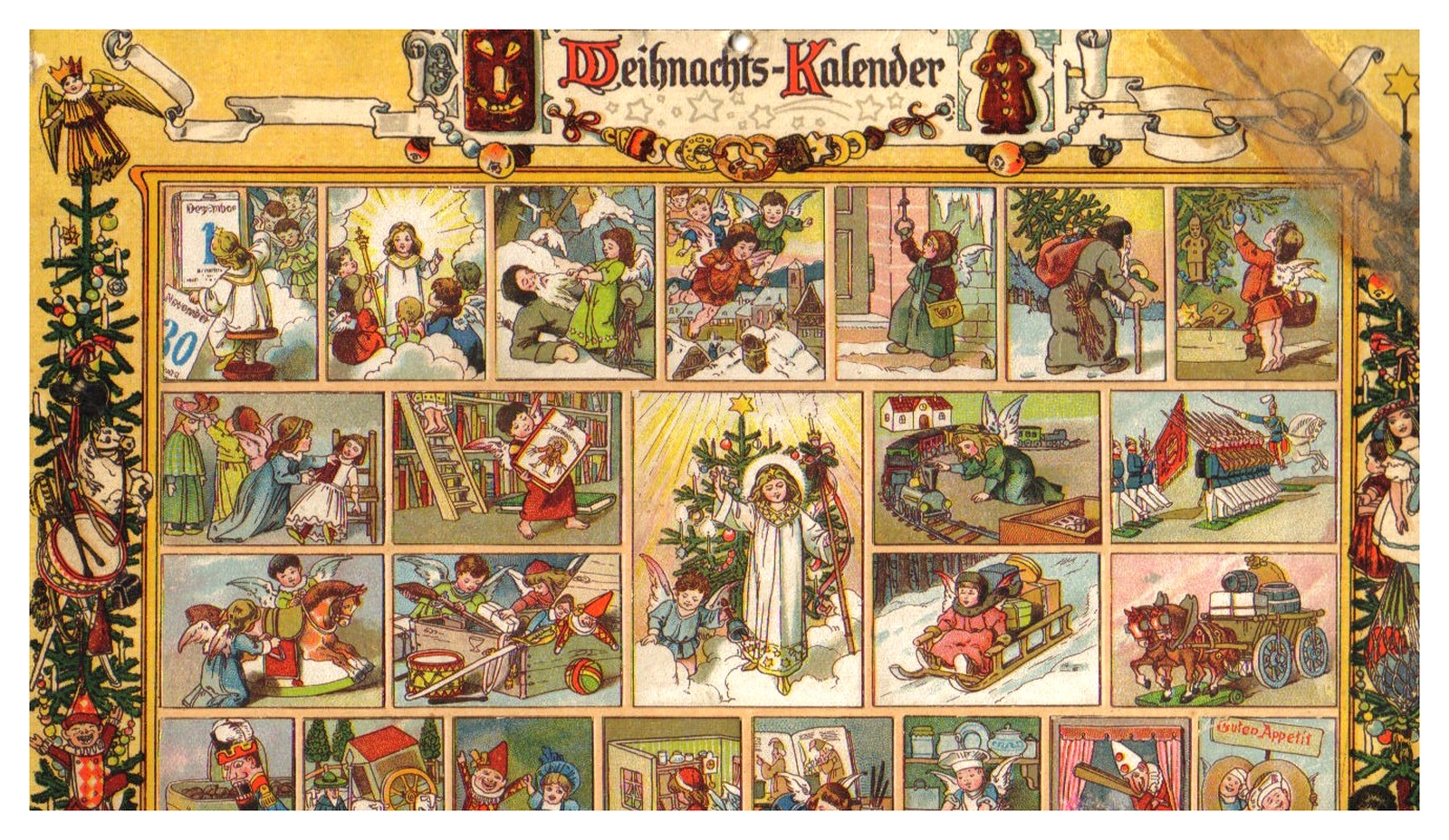
Printed calendars arrived in Germany in the early 1900s, though historians do not always agree on a single "first". A Hamburg Protestant bookshop published a Christmas clock for children around 1902 — useful, but covering only the back half of December. What most accounts call the breakthrough commercial format came from Gerhard Lang around 1908: Im Lande des Christkinds ("In the Land of the Christ Child"), a Munich lithograph with poems on one sheet and colourful pictures to cut out and stick on the other. Still no doors — the surprise was the paste, not a flap.
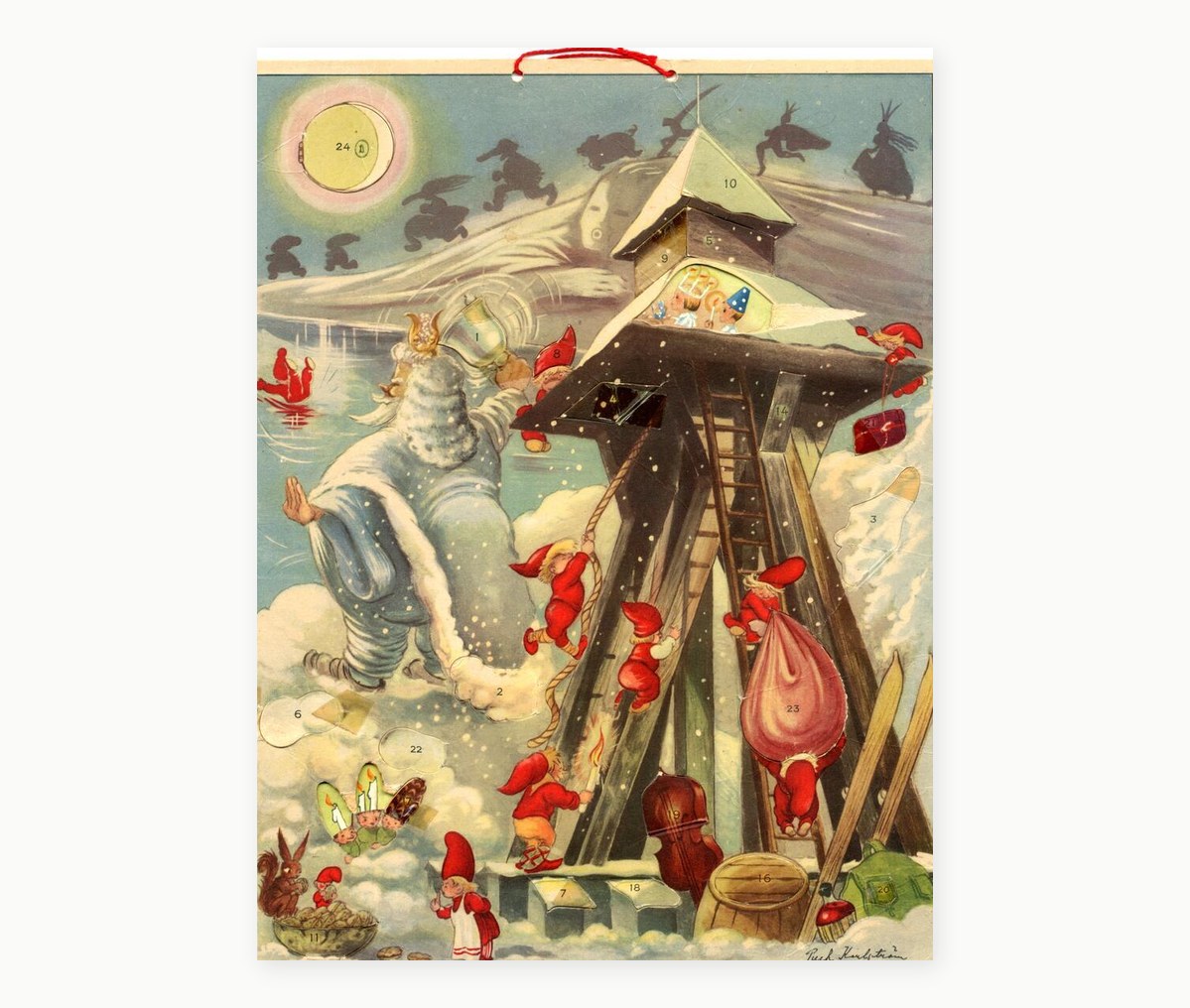

Opening windows followed around 1920. That is the format we recognise: a picture, a verse, or later a sweet, waiting behind a perforated square. Lang's firm poured out designs through the interwar years. Paper shortages and wartime politics later interrupted the trade; after 1945, publishers such as Richard Sellmer helped put picture calendars back into German — and then international — living rooms. American interest helped too: the 1950s saw Sellmer calendars travel widely, and a well-known Life magazine shot of the Eisenhower family with an advent calendar did the idea no harm in the US.
Crossing the Channel
In Britain, early calendars were imports or gifts from German and Scandinavian friends — novelty religious stock in cathedral shops and Christian bookstores, explained carefully because nobody assumed you already knew what one was. High-street sales take off in the mid-1950s. Contemporary ads from 1956 introduce a children's advent calendar that reveals a new picture each December day, already "extremely popular on the continent" and new to English shops at a couple of shillings.
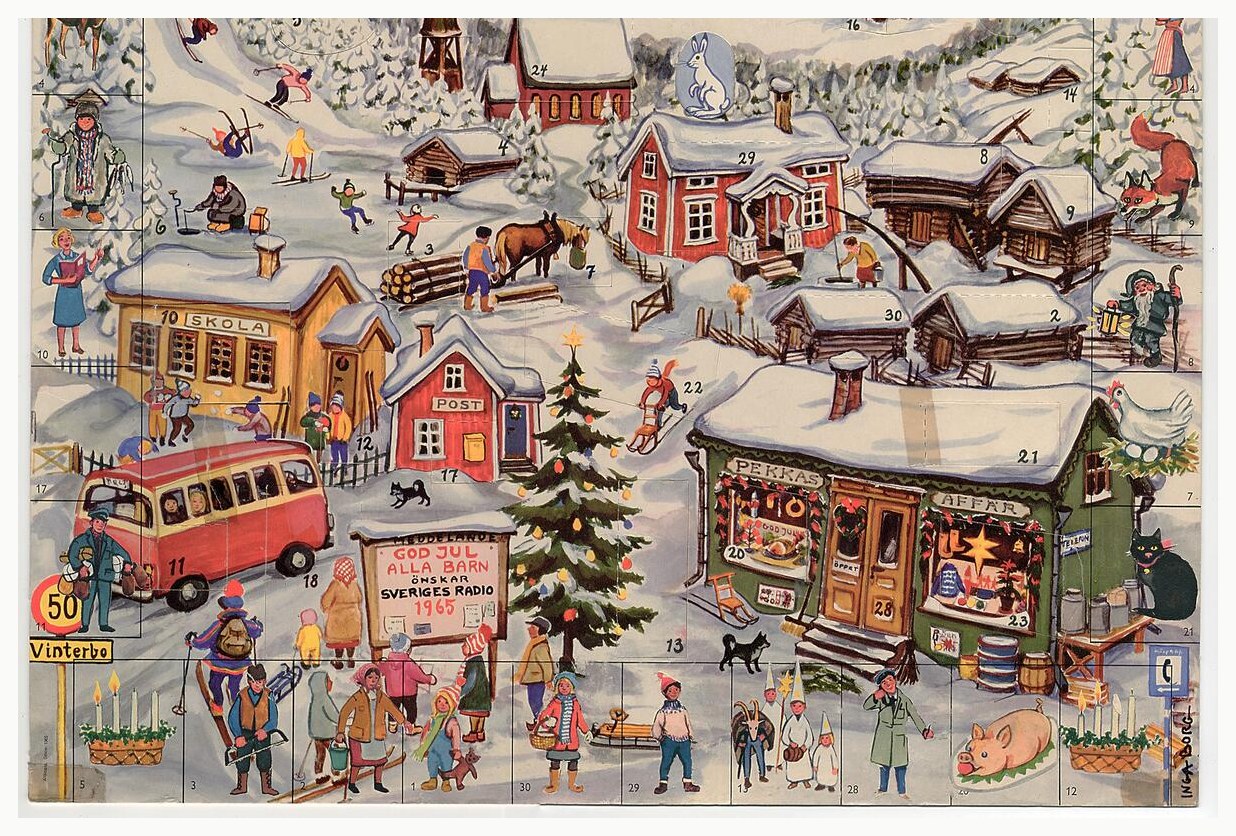

For decades the British default was cardboard and pictures, often ending on a nativity for the 24th. Chocolate was slower to stick than nostalgia suggests.
When chocolate took over
Filled chocolate calendars appear in German trade accounts from the late 1950s — 1958 is the year often cited for the first mass-market chocolate version. In the UK, Cadbury launched a chocolate advent calendar in 1971, produced it again in stretches through the 1970s and 1980s, then put it into continuous annual production from 1993. Nestlé's historians have noted that chocolate calendars only really became the everyday British norm in the 1990s. Rationing's long shadow and the cost of filling twenty-four doors help explain why the picture calendar held on so long.
Once chocolate won, the format was free to wander. Charities, brands and supermarket own-labels piled in. By the 2010s the UK had a full aisle of countdowns that barely glanced at cocoa: beauty, gin, beer, cheese, toys, tools, tea, candles. The religious frame is still there if you want it; the commercial frame is a daily treat with a sell-by date of Christmas Eve.
Why the UK still opens a door a day
Part of it is climate and calendar. British Decembers are dark, long and socially noisy — office parties, school plays, the slow march to the 25th. A door a day is a ritual small enough to fit a weekday morning and big enough to feel like progress. Part of it is gift culture: advent calendars sit between stocking filler and proper present, easy to wrap in a shopping list for mum, dad, kids and the person who already has everything.
And part of it is comparison shopping — which is where a site like December's Doors comes in. When a calendar costs anywhere from a supermarket fiver to a department-store splash, the useful questions are dull and necessary: what does it cost in pounds, what does the retailer claim it is worth, how many doors, and who is it actually for? The cardboard invention from Munich did not foresee full-size serums or wax-sealed gin drams. It did invent the habit of opening something small, once a day, until Christmas arrives.
The doors changed. The countdown did not.